

Scientific name: Durio zibethinus
Other names: Turen (Khmer people), Djoerian (Malay people),...
BOTANICAL CHARACTERISTICS
Durian originated in Malaysia, where the trees grow wild in forests (Sumatra and Kalimantan). In Vietnam, durian was introduced to the country very early (about 100 years ago) by Father Gernet. Durian is widely grown in the Mekong Delta, Southeast Vietnam, and the Central Highlands. Durian belongs to the Kapok family (Bombacaceae), genus Durio. Below are some botanical characteristics of the tree:
Roots
Durian roots can spread up to 6 - 8 meters. The roots can penetrate 5 - 6 meters deep into the soil. Root distribution depends on soil properties, groundwater, planting methods, and care techniques.
Trunk
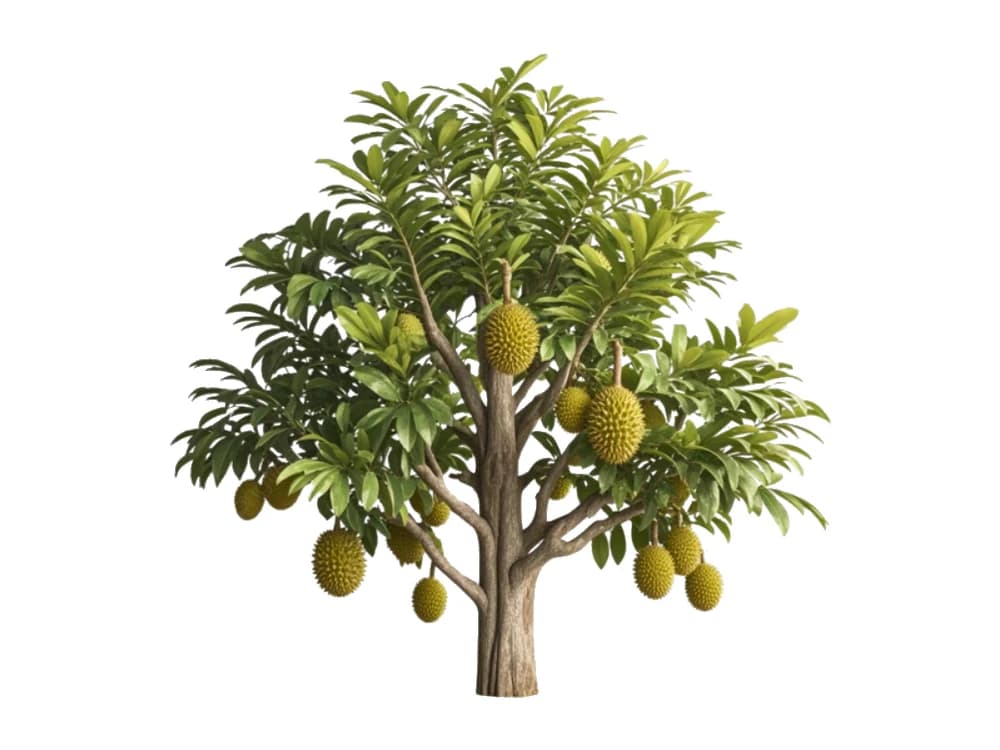
Durian is a perennial fruit tree with a straight trunk and many horizontal branches growing around it. The canopy diameter gradually increases with age.
For durian trees grown from seeds, the height is approximately 20 - 40 m; grafted durian trees are shorter, ranging from 8 - 12m.
Leaves
Durian leaves grow alternately and are simple, ovate in shape, with rounded or obtuse leaf bases. The leaves range from 12 - 20 cm in length and 4 - 6 cm in width. The petioles are 1.5 - 3 cm long.
In terms of leaf color, the upper surface is bright green, while the lower surface is shimmering brown and covered with fine, velvety hairs.
Flowers
Durian flowers grow in clusters, with each cluster containing 3 - 30 flowers. Durian flowers have thick, tubular stalks with joints and scales. The calyx has 5 lobes, the epicalyx has 3 lobes, and the petals are creamy green. The stamens are longer than the petals and consist of 5 bundles. The ovary is oval-shaped, with a long style and a smooth stigma divided into 5 parts. On average, each tree can produce up to 20.000 - 40.000 flowers.
Fruit
Young fruits are light brown and gradually turn bright green. The ovary has 5 chambers, each containing an average of 1 - 7 ovules, although not all ovules develop.
Durian fruits have chambers, each containing segments, and an average fruit has 12 - 13 seeds. The durian flesh is fragrant, soft, and sweet, although some fruits may have a slightly bitter taste.
GROWING CONDITIONS
Temperature: Durian is a tropical fruit tree, so it requires temperatures of 24 - 30oC. If temperatures remain below 13oC for an extended period, leaf drop and slow growth may occur, and the tree may even die.
Humidity: The suitable humidity level for tree growth is 75 - 80%.
Light: During the young tree stage, light intensity should be reduced to 30 - 40%. As the tree matures, it needs sunlight for full development.
Water and rainfall: The salt concentration in water must not exceed 1%0. Average annual rainfall ranges from 1.600 - 4.000 mm/year, with 2.000 mm/year being ideal.
Wind: Durian should be planted in areas with light winds. The tree cannot withstand strong winds, which can break the trunk and branches, cause fruit drop, and greatly affect yield.
Soil: The tree can be planted and grown in various soil types. Durian-growing soil should have a light texture, high organic matter content, good drainage, and a soil pH ranging from 5 - 6,5.